
The impending deadline of 1 October 2023, is here. Residential Aged Care will need to review their rostering and operations to conform to the updated care minutes and the 24/7 Registered Nurse Requirement standards.
The recent update included the following:
Care minutes can only be delivered by the following specified care workers:
- Registered nurses (RN)
- Enrolled nurses (EN)
- Personal care workers and assistants in nursing (PCWs/AINs).
Providers are funded through AN-ACC to have a sufficient mix of RNs, ENs and PCWs/AINs on duty to meet the care needs of residents at all times. This is so providers can deliver safe and quality care to residents living at their residential aged care services.
This era of transformative change in Aged Care comes with its challenges to the operations of the facility. In the following Newsletter we will overview the likely affect this will have on your organization.
Conducting a review on the structure and impacts of a roster on care minutes and star ratings in a healthcare or caregiving setting involves a systematic and data-driven approach. Here's a step-by-step process to guide you through this review:
Define Objectives and Scope
- Clearly define the objectives of the review. What specific aspects of the roster, care minutes, and star ratings do you want to assess?
- Determine the scope of the review, including the time frame, units, or departments to be included.
Gather Date
- Collect relevant data on roster schedules, including shift lengths, staffing levels, and employee assignments.
- Obtain data on care minutes provided to residents and gather historical star rating information.
Identify Key Metrics:
- Determine the key metrics you will use to evaluate the impacts of the roster. This would include current staffing direct care and non-direct care hours, overtime hours, benchmarking against Aged Care who are performing well.
Review Roster Structure:
- Analyze the current roster structure. Assess whether it aligns with best practices, regulatory requirements, and the specific needs with the self-directed care model.
- Understand your industrial instruments and Fair work requirements for consecutive shifts, shifts times and rostering requirements.
Assess Care Minutes:
- Evaluate the actual care minutes provided to residents compared to what is expected or required by regulatory standards.
- Determine if there are any patterns of understaffing or overstaffing that may impact care quality.
Analyze Star Ratings:
- Review historical star rating data and identify any trends or correlations with staffing levels, care minutes, or other relevant factors in particular staffing star rating.
- Determine if there are any specific star rating categories (e.g., patient satisfaction, quality of care) that are significantly impacted by staffing and care minutes.
Engage Stakeholders:
- Involve relevant stakeholders, including frontline staff, managers, and leadership, in the review process. Gather input and feedback on the current roster and its impact on care and star ratings.
Identify Challenges and Opportunities:
- Identify any challenges or shortcomings in the current roster structure and its impact on care quality and star ratings.
- Explore opportunities for improvement, such as optimizing scheduling, increasing staffing levels during peak demand, or enhancing staff training.
Develop Recommendations:
- Based on your analysis, develop a set of recommendations for improving the roster structure to better align with care quality and star rating goals.
- Prioritize these recommendations based on their potential impact and feasibility.
- Assess consultation requirements based on the level changes that will need to be made and impact to the relevant staff.
Implement Changes:
- Work with relevant stakeholders to implement the recommended changes to the roster structure and scheduling policies.
- Monitor the implementation process closely and address any challenges or resistance.
Evaluate Impact:
- Continuously monitor the impact of the roster changes on care minutes and star ratings. Assess whether the desired improvements are being realized.
- Adjust strategies and make further refinements as necessary.
Report and Communicate Findings:
- Prepare a comprehensive report summarizing the review process, findings, recommendations, and their implementation status.
- Communicate the results and action plans to relevant stakeholders and leadership.
Sustain and Review:
- Establish a process for ongoing review and evaluation of the roster's impact on care quality and star ratings. Adjust as needed to maintain or improve performance.
- Remember that the success of this review process relies on collaboration among different stakeholders, including frontline staff, management, and leadership. This will ensure that changes to the roster structure align with the overall goals of providing high-quality care and achieving positive star ratings.
It is important that the review works towards a further effective October 2024, increase in the resident care minutes an average of 215 a day.
Please note that only direct (personal) care administered by Registered Nurses, Enrolled Nurses, and Personal Care Workers will contribute to the total care minutes.
For further information, the following links provide different scenarios depending on where the facility is located, it?s capacity and level of workforce.
- Aged Care Quality and Safety Commission (ACQSC)
- 24/7 registered nurse coverage and care minutes in residential aged care fact sheet
- aged care workforce initiative and program
- National Nursing Workforce Strategy
- Build, train and support the aged care nursing workforce
Managing Psychosocial Hazards in accordance with Workplace Health and Safety Regulations for disability support workers
Some of the most common psychosocial hazards that can be encountered in the workplace include:
- Role overload: Too much to do in a set time or with insufficient workers or other resources.
- Role underload: Tasks or jobs where there is routinely too little to do.
- Exposure to traumatic events: emergency responders or healthcare workers.
- Role conflict or lack of role clarity: Uncertainty around roles, tenure, tasks, and work schedules and standards.
- Low job control: Have little control over how they do their work, when they can change tasks or take breaks.
- Conflict or poor workplace relationships between employees and supervisors: Frequent disagreements about how work should be done.
- Poor support from Supervisors or Managers: Inadequate information, advice, and help with work tasks or to resolve issues, access to necessary equipment and resources.
- Inadequate reward and recognition: Workers? efforts are not recognized.
Persons Conducting a Business or Undertaking (PCBUs) have the primary duty to ensure the health and safety of workers while they are at work, including their psychological health. Company directors and senior managers need to understand the nature of the PCBU's operations and hazards, allocate resources for health and safety management, and actively ensure the effectiveness of health and safety processes.
Actions and steps that are considered reasonable from managers and supervisors include:
- Leading, directing, and controlling how work is performed.
- Providing feedback and managing performance, including addressing inappropriate or harmful workplace behaviors.
- Resolving differences of opinion and disagreements.
- Managing recruitment, assignment, transfer, disciplinary actions, or employment termination.
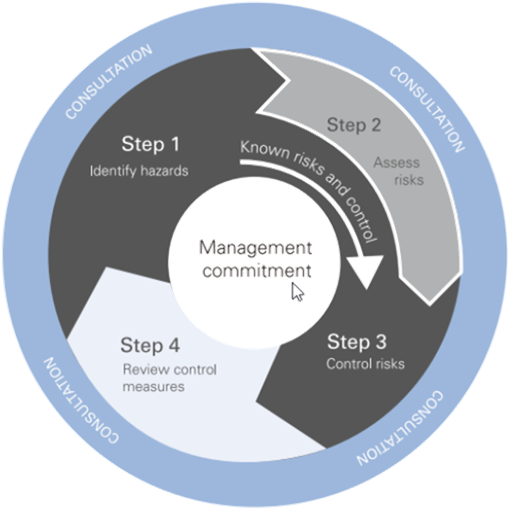
The Risk Management Process provides a guide for approaching psychosocial hazards in the workplace.
- Identify the Psychosocial Hazards
- Assess and Prioritize the Psychosocial Hazards and Risks
- Control Psychosocial Hazards and Risks.
- Proactively Implement, Maintain, Monitor, and Review the Effectiveness of Controls.
To investigate a psychosocial incident the following needs to be taken into account:
- incidents must be addressed with a fair, timely, and comprehensive investigation.
- Privacy and confidentiality must be protected, and due process ensured for all parties involved.
- Providing general information can be helpful if sensitive information is involved.
- Harmful workplace behavior is a WHS hazard and should be reported and managed systematically.
- Certain workplace incidents, such as a person's death or serious physical or psychological injury or illness requiring immediate treatment as an in-patient in a hospital, must be notified to the regulator immediately upon becoming aware of the incident. A record of each incident must also be kept.
The cumulative effect of Psychosocial Hazards includes chronic stress, excessive workload, strained relationships, and can lead to various negative outcomes.
Strategies for Mitigating Psychosocial Hazards:
- Promoting a positive work environment.
- Workplace Advice Line Building resilience and coping skills.
Ignite HR & Employment Law is supporting businesses to understand their obligations, upgrade their current policies, undertake training and information sessions for businesses. If you find yourself in a situation where a staff member makes allegations in relation to any of these workplace behaviours you may need to do an investigation we can assist in addressing a sexual harassment or bullying complaint.
Talk to us to understand your obligations